
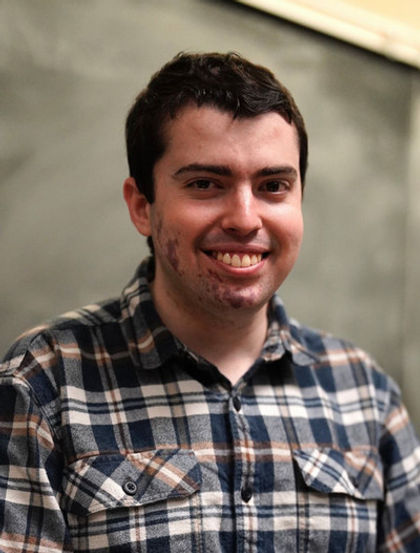
Jonathan Valyou
Applied and Computational Mathematics
Welcome to my webpage! I am Jonathan Valyou, an Applied and Computational Mathematics PhD candidate and Tam Family Fellow currently at Florida State University specializing in data assimilation, numerical linear algebra, and optimal control. I previously earned my Bachelor of Science in Applied Mathematics as a Robert W. Woodruff Scholar at Emory University in 2022. My work primarily focuses on integrating uncertainty into mathematical models and developing efficient algorithms for data assimilation. Explore my site to learn more about my background and research.
Research Interests
My research can be divided into three primary areas:
-
Ensemble-Based Data Assimilation
-
Optimal Control Under Uncertainty
-
Hybrid Quantum-Classical Correction Methods
Keep scrolling to learn more about these topics and publications.

Ensemble-Based Data Assimilation
My primary expertise is in the understanding, development, and optimization of data assimilation quantified through ensembles. Specifically, I work on reformulations of the Ensemble Kalman Filter (EnKF) for forward problems and the Ensemble Kalman Inversion (EKI) for inverse problems. Through this I designed the CGD-EnKF algorithm to reformulate the Kalman Gain computation with conjugate gradient to maintain a favorable accuracy-computation cost tradeoff for data assimilation problems with high observation dimensionality and non-diagonal observation covariance matrices. Additionally, I have worked extensively on the understanding and design of the Ensemble Conjugate Transport Inversion (ECTI) for accurate parameter estimations under non-gaussian priors.

Optimal Control Under Uncertainty
A second primary interest lies in the field of determining optimal paths under uncertain conditions. Focusing on ocean navigation, velocity forecast models can produce different ocean current conditions. A system of Hamilton-Jacobi partial differential equations can incorporate this forecast uncertainty and yields the mean reachability travel time and each ensemble member's deterministic travel time from a fixed starting position to an arbitrary end position within the domain. The system solution more crucially gives the necessary controls to find the associated mean-time and individual ensemble member's optimal paths.

Hybrid Quantum-Classical Correction Methods
A more recent interest within my research scope pertains to the development and noise analysis of hybrid quantum-classical methods. Currently constrained by limited qubits and restricted circuitry, quantum linear systems at fine-scale are infeasible. However, understanding coarse-scale quantum solves and preparing for the implementation of full scale quantum algorithms at this stage is promising. To do so, hybrid correction methods are developed where quantum computations are done on a coarse mesh and then classically corrected to the fine mesh solution approximation. I applied a method inspired by Variational Quantum Linear Solver (VQLS) to a Galerkin system solving both steady and time-dependent Darcy flow. Further studies of uncertainty impacts developed through quantum noise are needed.
Publications
K. Chawla, S. Lee, J. Valyou "A Hybrid Coarse-to-Fine Framework for Quantum Computing in Heterogeneous Darcy Flow", Under revision, SIAM Journal of Scientific Computing (2026)
S. Lee, Z. Liu, J. Valyou, L. Zikatanov "A Conjugate-Gradient Formulation of the EnKF Algorithm", Under revision, Journal for Computers and Mathematics with Applications (2026) - Available on arXiv
J. Valyou, J. Brandman, S. Lee "Optimal mean-time path planning for unmanned underwater vehicles: a Hamilton-Jacobi approach", Under revision, Journal of Scientific Computing (2026) - Available on arXiv
Education
2022 - Present
Ph.D. in Applied and Computational Mathematics, Florida State University
2022 - 2024
Master's Degree in Applied & Computational Mathematics, Florida State University
2018 - 2022
Bachelor of Science Degree in Applied Mathematics, Emory University